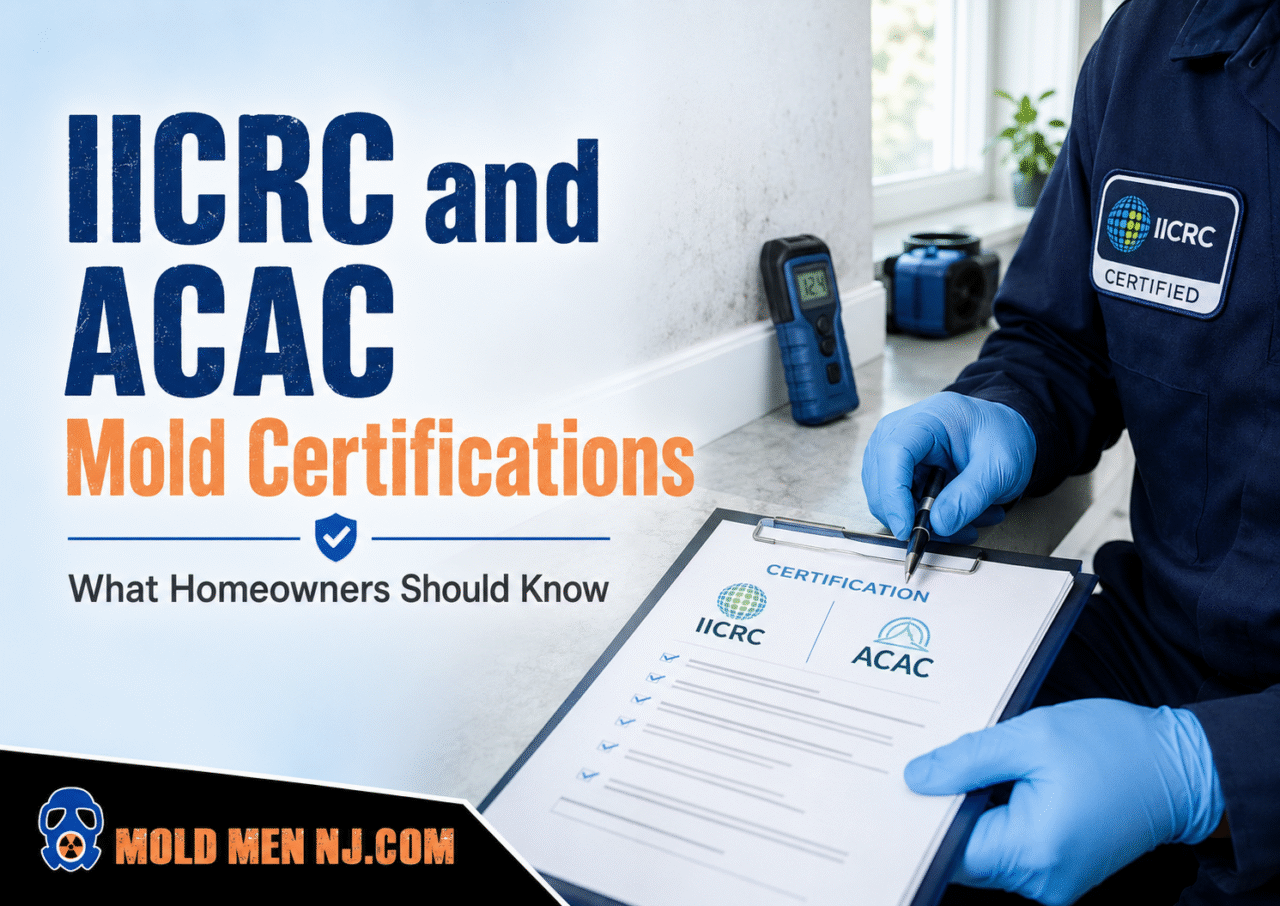
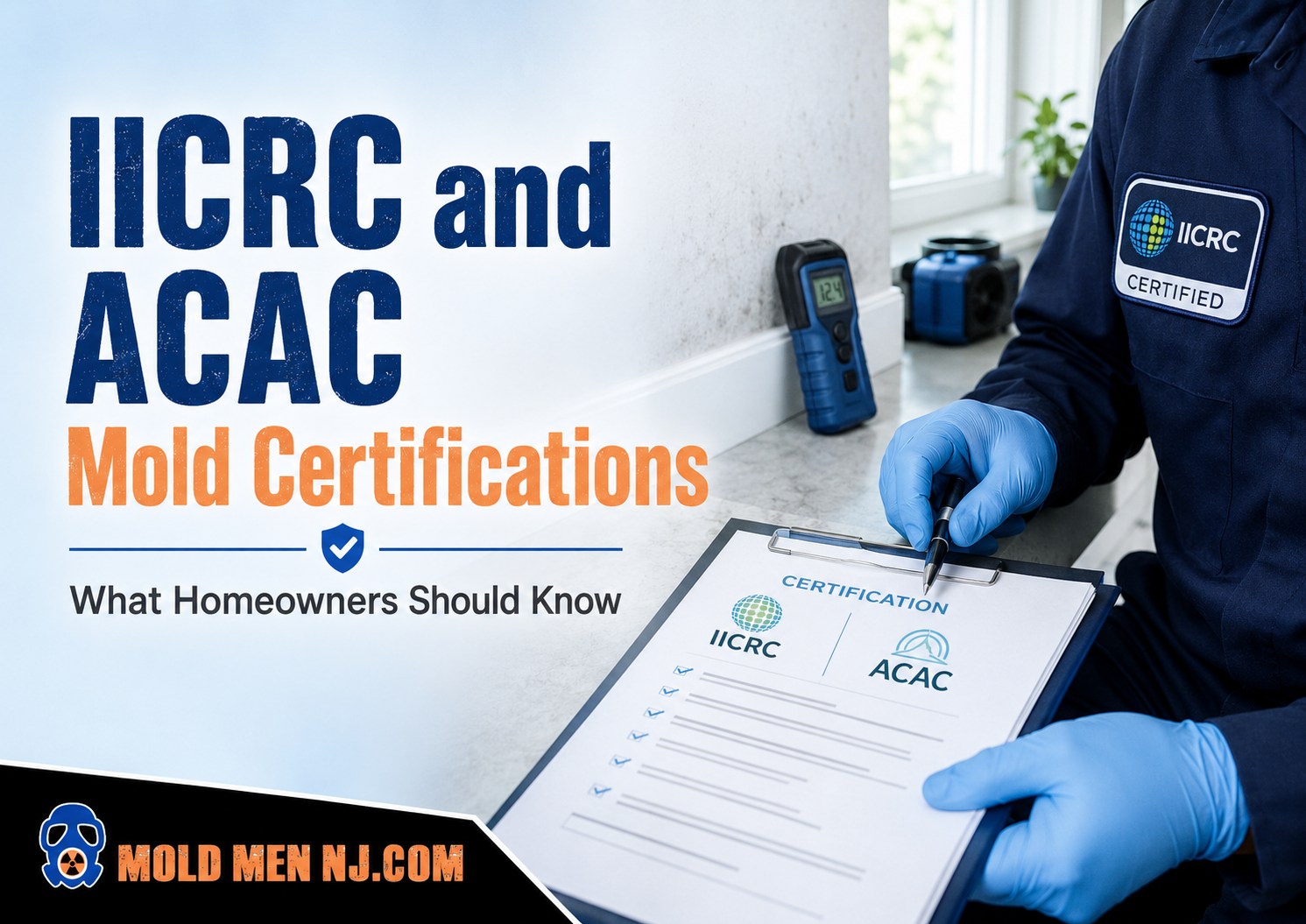
IICRC and ACAC Mold Certifications: What Homeowners Should Know
When homeowners find mold, one of the first questions is simple: who can I trust to handle this correctly?
Mold remediation is not just about wiping away visible growth. Mold problems often involve moisture, water damage, building materials, containment, cleaning, removal, drying, and prevention. That is why industry training and certifications can matter when choosing a mold remediation company.
At Mold Men NJ, we believe homeowners, homebuyers, real estate professionals, and property managers should understand what mold remediation certifications mean before hiring a company. Knowing common credentials like IICRC and ACAC can make it easier to ask better questions, compare providers, and choose a company that understands both mold and moisture.
Two certification organizations often mentioned in the mold and restoration industry are IICRC and ACAC.
Why Mold Remediation Certifications Matter
Mold usually starts with moisture. That moisture may come from a roof leak, plumbing issue, basement seepage, flooding, condensation, high humidity, HVAC issue, or water damage that was not dried properly.
A mold remediation company should understand more than the visible mold. The company should also understand why the mold appeared, whether the moisture source is still active, which materials may be affected, and how to help prevent the issue from returning.
Certifications do not replace experience, insurance, reviews, communication, or honest workmanship. However, they can show that a company or technician has invested in formal training and industry knowledge.
What Is IICRC?
IICRC stands for the Institute of Inspection Cleaning and Restoration Certification. It is one of the most recognized organizations in the cleaning, inspection, and restoration industries.
For mold and water damage companies, several IICRC certifications may be relevant.
IICRC AMRT: Applied Microbial Remediation Technician
IICRC AMRT stands for Applied Microbial Remediation Technician.
This is one of the most relevant IICRC certifications for mold-related remediation work. AMRT focuses on microbial remediation, including mold and sewage-related remediation techniques.
For homeowners, this matters because mold remediation may involve containment, removal of affected materials, cleaning, drying, and protecting unaffected areas.
IICRC WRT: Water Damage Restoration Technician
IICRC WRT stands for Water Damage Restoration Technician.
This certification focuses on water damage restoration. That is important because many mold problems begin after leaks, flooding, sump pump failures, roof damage, appliance leaks, or wet building materials that were not dried quickly enough.
A company that understands water damage restoration is better prepared to address the moisture problem behind the mold.
IICRC MRS: Mold Remediation Specialist
IICRC MRS stands for Mold Remediation Specialist.
This is a mold-focused credential related to mold remediation for structures and contents. For homeowners, the phrase “Mold Remediation Specialist” is easy to understand and can be a helpful trust signal when comparing mold companies.
What Is ACAC?
ACAC stands for the American Council for Accredited Certification.
ACAC offers certifications related to indoor environmental work, microbial investigation, mold inspection, mold consulting, and microbial remediation.
Some ACAC certifications apply more to remediation work, while others apply more to inspection, investigation, consulting, testing, or verification.
ACAC CMR and CMRS
ACAC CMR stands for Council-certified Microbial Remediator.
ACAC CMRS stands for Council-certified Microbial Remediation Supervisor.
These credentials are connected to mold remediation and microbial remediation experience. They may be relevant for professionals who perform or supervise remediation work in residential, commercial, industrial, public, or institutional buildings.
For property managers, real estate professionals, and larger projects, these credentials may be useful because remediation often requires planning, safety precautions, containment, communication, and documentation.
Mold Remediation vs. Mold Inspection
Homeowners often use the terms mold inspection, mold testing, and mold remediation interchangeably, but they are not always the same service.
Mold inspection usually focuses on evaluating whether a mold or moisture issue may be present.
Mold testing may involve collecting air or surface samples in certain situations.
Mold remediation focuses on correcting the mold problem, cleaning or removing affected materials, and addressing the conditions that allowed mold to grow.
In some real estate transactions or larger projects, both inspection and remediation may be involved.
What Should Homeowners Ask Before Hiring a Mold Company?
Certifications can be helpful, but they should not be the only factor homeowners consider.
Before hiring a mold company, ask:
Does the company understand both mold and moisture?
Can they explain the likely moisture source?
Do they provide mold remediation and water damage restoration services?
Do they use containment when needed?
Do they explain what materials can be cleaned and what may need removal?
Do they carry appropriate insurance?
Do they have strong reviews?
Do they explain how to reduce the chance of mold returning?
A good mold remediation company should be able to explain the issue clearly. You should understand what is affected, why it happened, what needs to be done, and what should happen after remediation.
Why This Matters for New Jersey Homes
New Jersey homes face many moisture-related risks.
Humid summers can raise indoor humidity. Cold winters can create condensation around windows, pipes, attics, and exterior walls. Heavy rain can lead to basement seepage, sump pump issues, roof leaks, and foundation moisture.
Older homes may also have aging plumbing, poor ventilation, finished basements, crawlspaces, attic moisture, and hidden water damage.
Because of these conditions, New Jersey homeowners should take mold concerns seriously, especially when mold is recurring, spreading, hidden, or connected to water damage.
Final Thoughts
IICRC and ACAC mold certifications can help homeowners, real estate professionals, and property managers better understand what kind of training a mold professional may have.
IICRC certifications such as AMRT, WRT, and MRS are especially relevant to mold remediation and water damage restoration. ACAC credentials such as CMR and CMRS may also be relevant for microbial remediation work.
The most important takeaway is simple: mold remediation should address both the mold and the moisture source.
If you are dealing with mold, musty odors, water damage, basement moisture, attic staining, or hidden growth concerns in New Jersey, Mold Men NJ can help.
FAQ
What are mold remediation certifications?
Mold remediation certifications are industry credentials that show a technician or company has completed training or met requirements related to mold remediation, water damage restoration, microbial remediation, inspection, or consulting.
What does IICRC AMRT mean?
IICRC AMRT stands for Applied Microbial Remediation Technician. It is one of the more relevant certifications for mold-related remediation work because it focuses on microbial remediation.
What does IICRC WRT mean?
IICRC WRT stands for Water Damage Restoration Technician. This certification is important because many mold problems begin after leaks, flooding, sump pump failures, roof damage, appliance leaks, or wet building materials that were not dried quickly enough.
What does ACAC CMR mean?
ACAC CMR stands for Council-certified Microbial Remediator. It is a credential connected to microbial remediation and mold remediation experience.
Are certifications the only thing homeowners should look for?
No. Certifications can be helpful, but homeowners should also consider experience, insurance, reviews, communication, moisture-source correction, and whether the company clearly explains the remediation process.
About Mold Men NJ
Mold Men NJ is a veteran-owned, licensed, certified, and insured company serving residential and commercial customers throughout New Jersey. Services include mold remediation, water damage restoration, fire restoration, and lead remediation.
Contact Mold Men NJ
Mold Men NJ
36 Banta Rd, Kinnelon NJ 07405
(201) 729-3220
moldmennewjersey@gmail.com
https://moldmennj.com/contact/
Disclaimer: Mold may affect people differently. This article is informational only. For health concerns, contact a healthcare provider. For mold concerns, contact Mold Men NJ.
